The Longest Internet Blackout in History Is Crippling Iran’s Economy
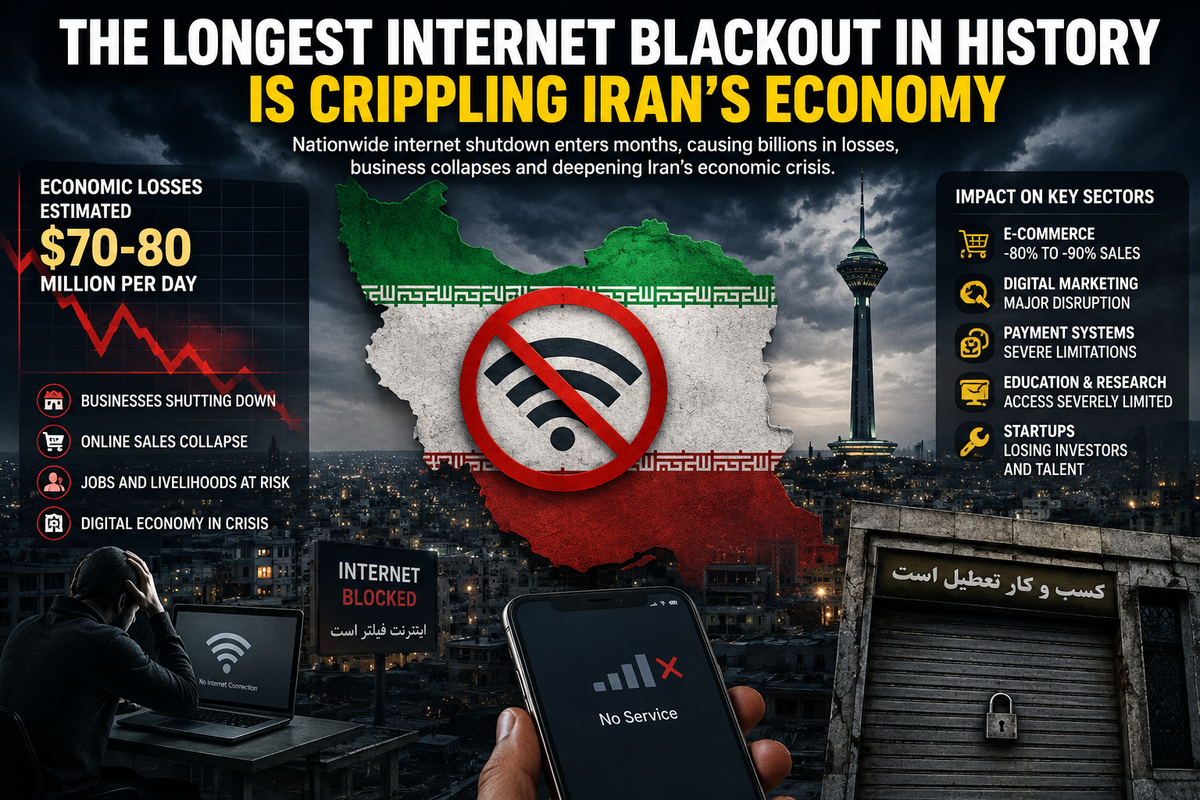
Iran is facing what internet monitoring organizations and researchers describe as one of the longest nationwide internet shutdowns ever recorded in a connected society, creating a growing economic crisis that is hitting businesses, workers, and ordinary citizens across the country. The prolonged digital blackout has severely disrupted commerce, communication, and access to global markets, adding new pressure to an economy already struggling under sanctions, inflation, and geopolitical tensions.
The nationwide disruption began in January 2026 during widespread protests and intensified again in late February amid escalating military tensions involving Iran, the United States, and Israel. Internet monitoring organization NetBlocks reported that connectivity levels at times dropped to just 1% to 4% of normal traffic levels, effectively disconnecting millions of Iranians from the global internet. Authorities have defended restrictions as security measures, while critics argue they are designed to control information flow and suppress dissent.
The economic consequences have been severe. Iranian officials estimated early shutdown losses at approximately $35 million daily, while independent analysts suggest direct and indirect damage could reach $70 million to $80 million per day. Online businesses have seen sales collapse, digital advertising networks have stalled, and internet-dependent industries are struggling to survive. By April, some estimates suggested the economic impact had already exceeded $1.8 billion.
Small businesses and entrepreneurs have been among the hardest hit. E-commerce companies, freelancers, digital marketers, and online retailers rely heavily on platforms that have become inaccessible or severely limited. Some businesses reportedly lost up to 80% to 90% of their customer acquisition channels as social media platforms and communication tools became unavailable. Several companies have announced layoffs, while others have shut operations entirely after months of disruption.
Iran’s technology ecosystem, once viewed as a growing sector within the country’s economy, has also suffered major setbacks. Online marketplaces, payment systems, logistics coordination, and remote work operations have faced significant disruptions. The uncertainty has pushed some skilled professionals to seek opportunities abroad, contributing to concerns about long-term economic damage and talent migration.
Internet restrictions have also affected daily life beyond business operations. Families have struggled to communicate with relatives abroad. Students and researchers have faced limited access to educational resources. Many Iranians reportedly turned to virtual private networks, satellite internet solutions, or even cross-border travel simply to regain connectivity. Authorities have simultaneously increased efforts to restrict alternative access methods.
Experts say Iran’s internet infrastructure allows authorities significant control over digital access through centralized systems developed over many years. While some limited connectivity has reportedly been restored for selected business sectors under programs designed to reduce economic harm, broad restrictions remain in place across much of society.
As the blackout continues, economists warn that prolonged digital isolation could deepen Iran’s financial challenges. What began as a security measure has evolved into a broader economic issue — one that may shape Iran’s digital future long after connectivity eventually returns.