Nvidia CEO Sounds Alarm on China’s AI Edge: “They Can Build a Hospital in a Weekend”
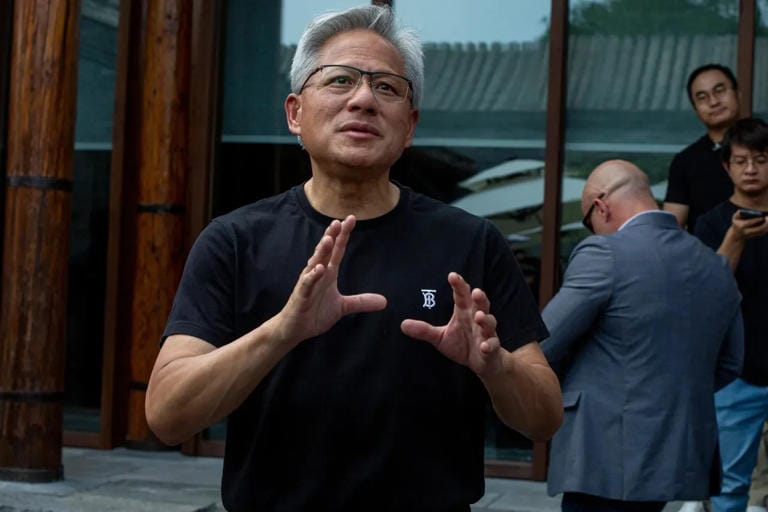
Nvidia CEO Jensen Huang recently opened up about the U.S.–China AI race, highlighting a critical factor that goes beyond chips and software—infrastructure speed and energy capacity. While the United States leads in AI chip technology, Huang warns that China’s ability to build massive projects almost instantly gives it a unique advantage.
U.S. Data Centers Take Years to Build
Huang compared the construction of AI infrastructure in the U.S. and China in a recent conversation with John Hamre, president of the Center for Strategic and International Studies.
He explained, “If you want to build a data center here in the United States, from breaking ground to running an AI supercomputer, it takes about three years. They can build a hospital in a weekend.”
This striking contrast highlights one of the hidden advantages China has in the AI race. While the U.S. faces lengthy bureaucratic approvals, construction challenges, and energy concerns, China can quickly mobilize resources and manpower to complete large-scale projects in record time.
Energy Capacity: Another Area Where China Pulls Ahead
Beyond construction, Huang flagged energy availability as a major factor in AI dominance. Running AI supercomputers requires enormous amounts of electricity, and China has a clear edge.
“China has twice as much energy as we do as a nation, even though our economy is larger,” Huang said. He noted that China’s energy capacity is still growing rapidly, whereas U.S. energy infrastructure has largely plateaued.
This difference could prove decisive as AI adoption accelerates, since computational demands are skyrocketing. Countries that can provide energy reliably and at scale will have a strategic advantage in deploying AI at a national level.
U.S. Still Leads in AI Chips
Despite China’s infrastructure advantage, Huang emphasized that Nvidia remains ahead of the curve in AI chip technology. The company’s chips power the world’s fastest AI supercomputers and are critical for training and running advanced AI models.
“We are generations ahead on AI chip design and manufacturing,” Huang said. However, he also cautioned against underestimating China’s manufacturing capabilities, noting that the country has a proven record of rapid industrial mobilization when necessary.
Nvidia’s Role in U.S. AI Expansion
Nvidia is part of a larger wave of investment in AI data centers in the United States, which experts predict could exceed $100 billion in the coming year. These facilities are essential for supporting the booming demand for AI computing power.
Raul Martynek, CEO of data center contractor DataBank, estimates that a typical AI data center costs $10–15 million per megawatt (MW) to build, and even smaller centers require around 40 MW. This means the U.S. could be spending $50–105 billion just in the next year to keep up with AI demand.
The Growing Pressure of AI Demand
Huang’s comments come amid a global surge in AI adoption, from generative AI tools to autonomous systems. The demand for AI-ready infrastructure is “insatiable,” according to industry insiders. Every new AI model or service requires massive computation power, which in turn drives the need for more data centers and energy resources.
This growing demand also underscores the urgency for the U.S. to streamline approvals, expand energy infrastructure, and invest in faster construction if it wants to maintain a technological edge over China.
The U.S.–China AI Race: A Bigger Picture
The AI race is not just about who can make the fastest chips or smartest algorithms—it’s also about how quickly a country can deploy infrastructure and support technology at scale. Huang’s comparison between U.S. and Chinese construction speeds makes this clear: a nation’s ability to build large projects efficiently can influence its technological leadership.
While the U.S. retains a strong lead in AI innovation and chip technology, China’s rapid construction, growing energy capacity, and industrial coordination provide it with a formidable strategic advantage.
Balancing Innovation with Infrastructure
Huang’s observations highlight a broader lesson for policymakers and tech companies: technological innovation alone is not enough. To compete effectively, nations must ensure their infrastructure, energy supply, and construction capabilities are ready to support next-generation AI systems.
For Nvidia and other AI leaders, this means investing in domestic data centers, partnering with energy providers, and lobbying for faster approvals to build critical AI infrastructure. Meanwhile, the U.S. government and private sector must address energy and regulatory bottlenecks to prevent falling behind in the global AI race.
Looking Ahead
Despite the challenges, Huang remains optimistic about Nvidia’s future in the U.S., citing policies aimed at reshoring manufacturing and boosting AI investment.
“Even with China’s advantages in infrastructure, the U.S. can maintain its lead if we continue innovating in AI chips and build the necessary infrastructure,” he said.
As AI adoption accelerates worldwide, the race is no longer just about who creates the smartest technology, but also about who can deploy it fastest and at scale. How the U.S. responds to these challenges in the coming years could determine its standing in the global AI hierarchy.