Moore Threads Surges 425% in Shanghai IPO, Overtaking Nvidia’s Exit in China
Moore Threads Soars 425% in Shanghai Debut
Chinese AI chipmaker Moore Threads Technology Co. made a spectacular 425% jump in its first day of trading on the Shanghai Stock Exchange. The company raised 8 billion yuan ($1.13 billion) in one of the largest onshore IPOs of the year. This marks the biggest first-day gain for a major IPO since China’s market reforms in 2019.
Retail investors drove enormous demand, oversubscribing the offering 2,750 times, even after a clawback. The debut also surpassed Semiconductor Manufacturing International Corp.’s 2020 IPO surge of 202%, setting a new benchmark for Chinese tech listings over $1 billion.
Why Investors Are Excited
Moore Threads’ IPO comes at a time when China is aggressively promoting tech self-sufficiency, fueled by trade tensions and concerns about US technology restrictions. Recent easing of listing rules for unprofitable companies on the Star Board also boosted investor confidence in homegrown startups.
According to Shao Qifeng, Chief Investment Officer at Ying An Asset Management, “A surge of this scale can be expected from strong demand. However, such memorable IPOs don’t always bode well for the broader sector and may indicate market froth.”
Moore Threads’ Market Position
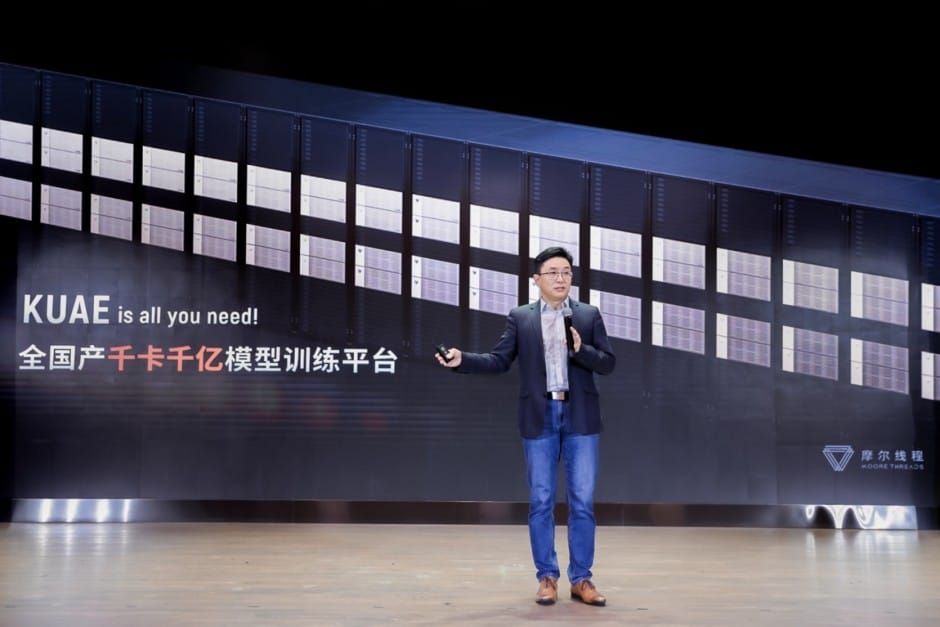
Founded in 2020 by former Nvidia executive Zhang Jianzhong, Moore Threads initially focused on graphics chips for gaming and visual rendering before pivoting to AI accelerators, which power large language models and other AI applications.
The company is now seen as a competitor to:
- Cambricon Technologies Corp.
- Huawei Technologies Co.
- Potential AI chip units from Baidu Inc.
This positioning comes in the wake of Nvidia’s partial exit from China, leaving a gap in the AI chip market that Moore Threads is eager to fill.
IPO Details and Financials
- IPO raised: 8 billion yuan ($1.13 billion)
- Debut market cap: 282.3 billion yuan, roughly half of Cambricon’s 571.4 billion yuan
- Net loss (first 3 quarters of 2025): 724 million yuan, down 19% from last year
- Revenue growth: 182% to 780 million yuan
Despite strong investor interest, Moore Threads’ valuation is highly ambitious. Its price-to-sales ratio sits at 123 times the offer price, above the average of 111 times for peers. The company recently reminded investors of the risks associated with such valuations.
Challenges Ahead
Moore Threads faced hurdles in October 2023 when the US Commerce Department added the company to its entity list, restricting access to key technologies. This led to job cuts and restructuring, yet Beijing’s support for the domestic AI chip sector has helped maintain investor optimism.
The company plans to use IPO proceeds to:
- Fund next-generation AI and graphics chip projects
- Boost working capital for operations
Broader Impact on China’s AI Chip Market
The IPO has sparked strong interest in the sector, with investors rotating out of smaller related stocks. For example, Shenzhen H&T Intelligent Control Co., which holds a minor stake in Moore Threads, fell 10% after the debut.
Other Chinese chipmakers are now exploring IPOs:
- MetaX Integrated Circuits Shanghai Co. opened subscriptions recently
- Yangtze Memory Technologies Co. and ChangXin Memory Technologies Inc. are considering onshore listings, potentially valuing each at up to 300 billion yuan
According to fund manager Chen Zunde, “The strong debut is consistent with muted market sentiment and investor enthusiasm toward new listings. However, there is concern it could draw funds away from peers and add pressure on the sector.”
Why Moore Threads Matters
Moore Threads’ successful IPO signals that China’s push for domestic AI technology is gaining traction. With strong state support and investor appetite, the company is poised to become a flagship in China’s AI chip market, alongside Cambricon and Huawei.
If Moore Threads continues to grow, it could set a precedent for other Chinese AI chip startups seeking capital, further strengthening China’s self-reliance in semiconductor and AI technology.