JPMorgan CEO Says AI Layoffs Could Backfire and Trigger Social Unrest
AI Anxiety Grows as Companies Push for Leaner Workforces
More than three years after ChatGPT entered the mainstream, artificial intelligence continues to spark anxiety across workplaces around the world. While companies celebrate rising productivity, many workers—especially younger employees—are increasingly worried about job security.
In corporate America, pressure to do more with fewer people is mounting. Automation tools are improving rapidly, and businesses are eager to cut costs. But one of the world’s most powerful bankers is urging caution.
Jamie Dimon, CEO of JPMorgan Chase, believes rushing into AI-driven job cuts without a safety net could have serious consequences—not just for workers, but for society at large.
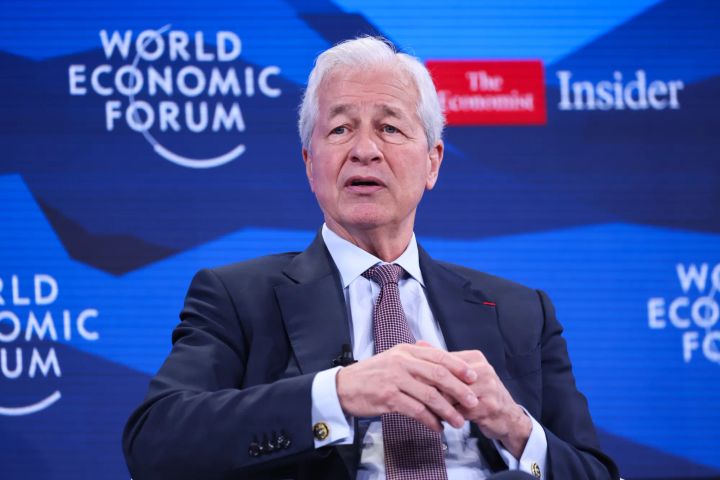
Speaking at the World Economic Forum in Davos, Switzerland, Dimon acknowledged that AI will reduce the need for human labor in the coming years. At the same time, he warned that careless mass layoffs could lead to social instability and even civil unrest.
Jamie Dimon’s Warning: Progress Without Protection Can Backfire
Dimon, who leads America’s largest bank with more than 300,000 employees, was candid about the future. He expects JPMorgan to need fewer workers over the next five years as technology becomes more efficient.
However, he strongly believes companies must handle the transition responsibly.
“You are not going to slow this down,” Dimon said, referring to AI’s rapid advancement. “But you can plan for it.”
He stressed that replacing large numbers of workers too quickly could leave millions without income, skills, or direction. That kind of disruption, he warned, could fuel widespread anger and unrest.
Rather than letting automation run unchecked, Dimon said he would even support government intervention if needed to protect workers and society.
A Rare Corporate Stance: Supporting Limits on AI Layoffs
In a surprising move, Dimon said he would welcome government rules—or even bans—that prevent companies from replacing masses of workers with AI overnight.
“If we have to do that to save society, we would agree,” he said.
This stance stands out in an era when many executives resist regulation. Dimon’s message was clear: innovation should not come at the cost of social stability.
He also suggested that local and regional governments could play a role by offering incentives that encourage companies to retrain and redeploy workers instead of firing them.
Retraining Over Replacing: Dimon’s Plan for Workers
Dimon said he already has a strategy in mind for handling job displacement at JPMorgan.
“I have a plan to retrain people, relocate people, income-assist people,” he explained.
Instead of cutting jobs abruptly, Dimon wants to help workers transition into new roles or build new skills that remain valuable in an AI-driven economy.
He believes businesses have a responsibility to invest in their people, especially when technological change is reshaping industries faster than ever before.
The Trucking Industry Example: A Cautionary Tale
To illustrate his concerns, Dimon pointed to the U.S. trucking industry, which employs roughly two million people.
With self-driving technology advancing rapidly, fully autonomous trucks could one day replace human drivers. Many of those drivers currently earn strong incomes, sometimes well into six figures.
“You can’t lay off two million truckers tomorrow,” Dimon said. “Phase it in. Retrain.”
Sudden automation, he argued, would devastate families and communities. A gradual rollout, combined with retraining programs, would allow workers to adapt without being pushed into financial hardship.
Are AI Job Losses Already Happening?
So far, large-scale AI-driven layoffs remain limited. According to recruitment firm Challenger, Gray & Christmas, about 55,000 jobs were cut due to automation in 2025.
While that number represents more than 75 percent of all AI-related layoffs since 2023, it is still small compared to total employment figures.
But experts warn that this could be just the beginning.
AI Pioneers Warn the Worst Is Yet to Come
Geoffrey Hinton, often referred to as the Godfather of AI, has issued much darker predictions.
He has warned that wealthy individuals and corporations will increasingly use AI to replace workers, concentrating profits while leaving millions unemployed.
“It’s going to create massive unemployment and a huge rise in profits,” Hinton said. “It will make a few people much richer and most people poorer.”
Hinton emphasized that the problem is not AI itself, but how it is deployed within existing economic systems.
Dimon’s comments stand in contrast to these fears, offering at least some reassurance that powerful business leaders are beginning to think about long-term consequences.
Learning From Past Failures
Still, Dimon admitted that worker protection programs have not always worked as intended.
He cited the U.S. Trade Adjustment Assistance program, which was designed to help workers displaced by offshoring. According to Dimon, it was poorly executed and failed many of the people it was meant to support.
That history, he said, should not discourage better planning in the AI era.
“Don’t put your head in the sand,” Dimon warned. “It is what it is.”
Billionaires and the Future of Work
Dimon is not alone in thinking about how AI could reshape society.
Elon Musk has repeatedly said that advances in AI and robotics will eventually eliminate the need for most human labor. According to Musk, universal income will become unavoidable.
“There will be no poverty in the future,” Musk has said. “There will be universal high income.”
OpenAI CEO Sam Altman has also advocated for guaranteed income, arguing that people will need financial security as traditional jobs disappear.
Altman has said that as technology creates massive wealth, governments must find ways to distribute it fairly so people can live with dignity—even without conventional employment.
A Turning Point for AI and Society
Jamie Dimon’s remarks signal a shift in how some corporate leaders view AI’s impact. While efficiency and profit remain important, there is growing recognition that unchecked automation could tear at the social fabric.
As AI continues to advance, the challenge will be finding a balance—one where innovation thrives without leaving millions behind.
Whether governments, corporations, and workers can navigate that transition successfully remains one of the biggest questions of the coming decade.