China Is Exporting Its Factories Across the World and Spooking the Competition
China is rapidly expanding its manufacturing footprint across the globe, building factories in countries ranging from Southeast Asia and Africa to Europe and Latin America. The strategy, driven by rising geopolitical tensions, trade barriers, and increasing domestic production costs, is reshaping global supply chains and creating growing anxiety among competitors worldwide.
For decades, China earned the title of “the world’s factory” by producing everything from electronics and machinery to clothing and electric vehicles at massive scale. Now, Chinese companies are increasingly moving parts of their manufacturing operations overseas, investing billions of dollars into foreign production facilities while maintaining control over supply chains, technology, and exports.
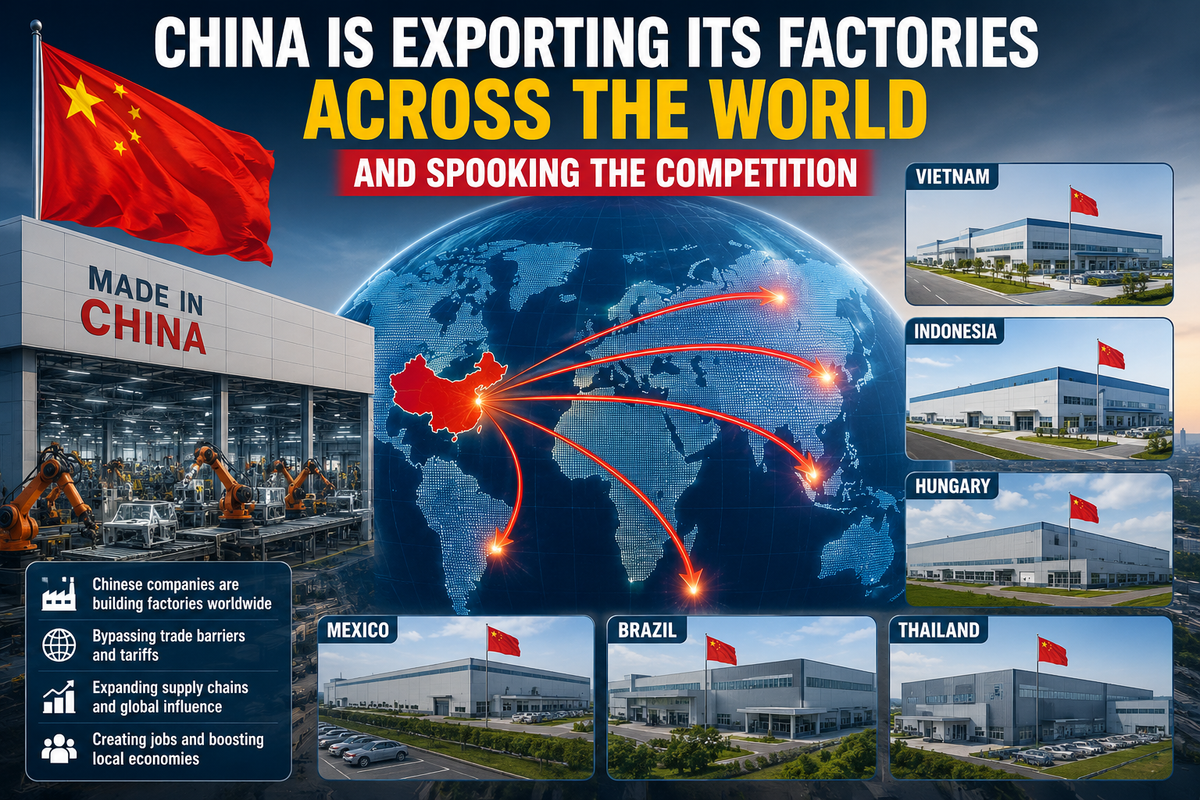
Analysts say the shift accelerated after the U.S.-China trade war, which led to tariffs on Chinese goods and pushed many firms to seek alternative production hubs. Chinese manufacturers began establishing factories in countries such as Vietnam, Thailand, Mexico, Indonesia, Hungary, and Brazil to avoid tariffs and gain easier access to foreign markets.
The electric vehicle sector has become one of the clearest examples of this trend. Major Chinese automakers and battery manufacturers are setting up production plants across Europe, Southeast Asia, and South America as demand for affordable EVs grows globally. Chinese solar panel makers, electronics producers, and textile companies are also expanding aggressively abroad.
Supporters argue that Chinese investment brings jobs, infrastructure development, and economic growth to host nations. In many developing countries, Chinese-backed factories have created thousands of manufacturing jobs and improved transportation networks. Governments seeking industrial growth often welcome the investments because they can help modernize local economies and attract additional foreign capital.
However, the rapid global expansion of Chinese manufacturing is also alarming competitors and policymakers. Western companies fear they may struggle to compete with Chinese firms that benefit from large-scale production capabilities, lower operating costs, and strong government support. Industry leaders in Europe and the United States have warned that China’s overseas manufacturing push could further increase its dominance in critical sectors such as electric vehicles, batteries, renewable energy, and electronics.
Some countries are also worried about becoming overly dependent on Chinese-controlled supply chains. Critics argue that while factories may physically operate abroad, many still rely heavily on Chinese technology, machinery, financing, and management systems. This has sparked concerns over economic influence and national security in several regions.
The European Union and the United States have both introduced measures aimed at protecting domestic industries from what they describe as unfair competition. Governments are increasingly offering subsidies and incentives to encourage local manufacturing and reduce strategic dependence on foreign supply chains.
Despite the concerns, Chinese companies continue to expand internationally at a rapid pace. Economists say the strategy allows firms to maintain export growth even as global trade restrictions tighten. By producing goods closer to international markets, Chinese manufacturers can bypass tariffs, reduce shipping costs, and strengthen their global presence.
Experts believe the global manufacturing race is entering a new phase where countries are competing not only for trade dominance but also for control over future technologies and industrial ecosystems. China’s aggressive overseas factory expansion is likely to remain a defining feature of the global economy for years to come, intensifying competition across industries worldwide.